Buying a new build home in 2026 comes with stronger consumer protections than ever before. Those protections only work in your favour if you know exactly what is wrong with your home and report it at the right time.
A professional snagging survey gives you that evidence. This guide walks you through what a snagging survey covers and what it does not, when to book one, what it costs, your new right to a Pre-Completion Inspection under Version 2 of the New Homes Quality Code, and how to get snags fixed (and escalate them if your developer drags its feet).
If you are completely new to the subject, our simple guide to snagging for new build buyers covers the basics. Our article on which surveyor you need for a new build home explains how snagging differs from other types of survey. This guide focuses on the practical side of getting a snagging survey done and making it count.
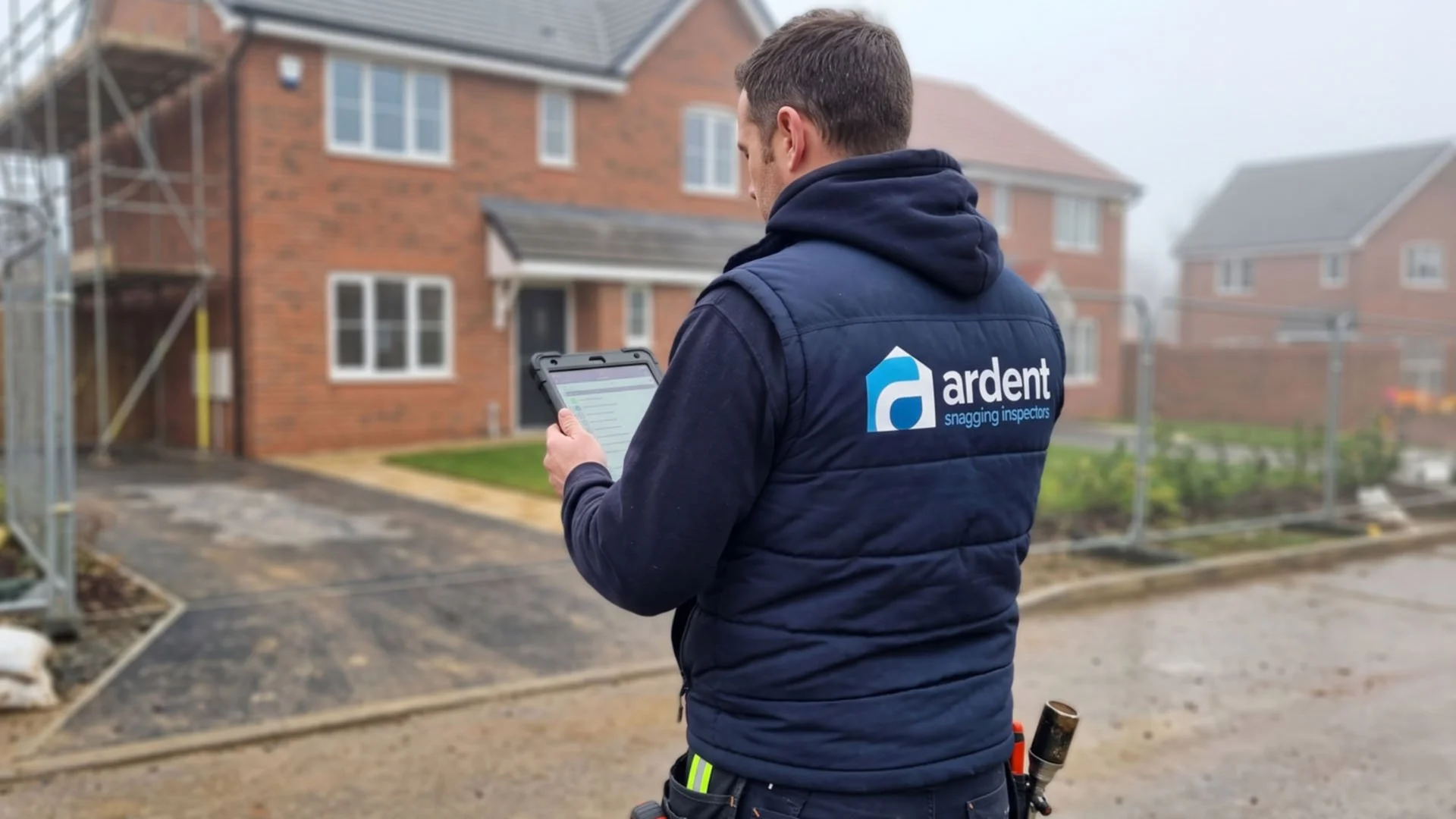
Do new build homes really have snags?
Yes, and the industry's own figures show it. The Home Builders Federation's National New Homes Customer Satisfaction Survey, published on 24 March 2026, is run independently by new home warranty providers, and Ipsos verifies the data. It drew on more than 36,000 buyers who responded eight weeks after moving in between October 2024 and September 2025. According to the survey, 93% of buyers had reported problems to their builder since moving in, and nearly a quarter reported 16 or more. The previous year's survey was much the same: 93.7% reported problems and 26.2% reported 16 or more.
The HBF says that in the vast majority of cases these issues are very minor, such as a paint drip. The same survey found that 90% of buyers were satisfied with the overall quality of their home, and 88% were happy with the service provided after they moved in. Both things can be true. A home can be well built overall and still have dozens of finishing items that need putting right. The real question is not whether your new home has snags, but whether you find them and report them in time for the developer to fix them at its own cost.
Escalated complaints are also rising. The New Homes Quality Board reported that the New Homes Ombudsman closed 904 cases in 2025/26, while cases settled through early resolution rose from 186 to 575. Trade press coverage of the Ombudsman's annual report showed formal complaints rising by 204%, from 593 in 2024/25 to 1,802 in 2025/26. The proportion of decisions made in favour of homeowners rose from 78% to 82%, and total compensation awarded rose to nearly £215,000. Defects and snagging were the most common reasons for complaints, and cases were more likely to escalate where developers had been slow to respond. A clear, well-evidenced snagging report from the outset is the best way to avoid ending up in that position.
What a snagging survey covers, and what it does not
A snagging survey is a detailed inspection of the quality of workmanship and standard of finish in your new home. A good inspector works methodically through every accessible room and the external areas directly associated with your property. They check whether finishes, fixtures, fittings and services have been completed to the standard your developer and its warranty provider require.
It is just as important to understand what a snagging survey is not. Snagging is not a structural survey. It does not assess foundations, load-bearing walls, the structural frame or the structural integrity of your home. It is also not a formal building regulations compliance check, because that responsibility sits with Building Control and your warranty provider. Structural problems that appear later are covered by the structural insurance part of your ten-year warranty. If you have a complex or persistent problem that needs deeper investigation, our intrusive snagging surveys are designed for exactly that.
Common snags we find in new build homes
Every home is different, but the same types of issue appear again and again. These are some of the snags we regularly record, grouped by area:
Walls and ceilings: visible plasterboard joints, popped screw heads, uneven paint coverage, runs and paint splashes on switches and sockets.
Doors and windows: doors that catch, will not latch or have uneven gaps, damaged frames, scratched glazing, incomplete perimeter seals and missing keys.
Kitchens: misaligned cupboard doors and drawers, chipped or scratched units and worktops, missing handles and untidy sealant.
Bathrooms and en suites: patchy or missing silicone, voids in grout lines, loose toilets and basins, slow drainage or gurgling waste pipes.
Joinery and floors: gaps under skirting boards, creaking stair treads, rippled carpets and missing threshold strips.
Services and loft: extractor fans that do not run, radiators that are not level or show signs of leaks, unlabelled consumer units, unevenly laid loft insulation and disconnected ductwork.
Outside: chipped bricks, inconsistent or missing mortar, poorly hung gates, damaged fence panels, debris left in gardens and paths with trip hazards.
The NHQB Pre-Completion Inspection Checklist gives a sense of the tolerances involved. For example, the gap between skirting and floor should be a maximum of 5mm. Any fire doors within a house should have gaps of between 2mm and 4mm at the head and sides, and no more than 4mm at the base. A trained inspector knows these standards and measures against them, rather than relying on whether something simply looks right.
What thermal imaging adds
Our New Build Snagging Checklist inspections include basic thermal imaging as standard, at no extra cost. A thermal camera shows surface temperature patterns that are invisible to the naked eye. That helps us spot signs of missing or displaced insulation, thermal bridging and air leakage around windows, doors and loft hatches. These are faults that can affect your comfort and your heating bills for years, yet they are easily missed in a purely visual inspection.
It is worth being clear about the limits. A thermal camera does not see through walls. It reads surface temperatures, and it works best when there is a meaningful difference between inside and outside temperatures. A cold patch is a reason to investigate further, not proof of a specific defect, because cold areas can also be caused by air movement, moisture or an unheated space next door. Where thermal imaging points to a problem that needs proper investigation, an intrusive survey can follow it up.
Thermal performance is becoming more important, not less. The government published the Future Homes Standard on 24 March 2026. It comes into force on 24 March 2027, with a transition period running to March 2028. In practice it means heat pumps, rooftop solar panels and tighter insulation and airtightness standards for new homes in England. As homes become more reliant on insulation and airtightness to perform well, workmanship faults in those areas matter more.
*Please note that thermal imaging is not included in our Pre-Completion Inspections.
Your Pre-Completion Inspection rights under the New Homes Quality Code Version 2
The single biggest change for new build buyers in 2026 is Version 2 of the New Homes Quality Code. The Code is run by the New Homes Quality Board (NHQB). If you reserved your home on or after 2 March 2026 from a developer registered with the NHQB, Version 2 applies to your purchase. If you reserved before that date, Version 1 applies. You can check whether your developer is registered on the NHQB's Register of Developers.
Under Version 2, the developer must give you the opportunity to carry out a pre-completion inspection yourself or to appoint a suitably qualified inspector to carry it out for you. The inspection should take place after the notice to complete has been served and before the completion date, or earlier if you and the developer both agree. The completion notice period is usually expected to be at least 14 calendar days unless you and the developer agree otherwise, partly so that there is time for the inspection to happen.
The new element in Version 2 is that buyers can now carry out the inspection themselves. If you choose to, the developer must tell you that you need to use the standard NHQB Pre-Completion Inspection Checklist. The developer must also warn you that the inspection was designed to be carried out by a professional, so you may miss some requirements or interpret the standards differently.
Who counts as a suitably qualified inspector?
If you appoint someone to carry out your Pre-Completion Inspection, the Code says they must meet four requirements. They must be a member of a recognised professional association experienced in residential surveying (the Code gives CABE, CIOB, ICWCI, RICS and RPSA as examples). They must hold relevant professional indemnity insurance. They must only work within their competency. And they must use only the standard NHQB Pre-Completion Inspection Checklist.
What a PCI can and cannot include
The NHQB checklist sets out how the inspection must be carried out, and it is deliberately limited. The inspection must be non-disruptive and non-invasive, and it should test fixtures, fittings and services in the way you would use them day to day. Internal walls, ceilings and paintwork are inspected in daylight from a minimum distance of two metres, without shining a light on the surface. Glazing is viewed from at least two metres (three metres for laminated or toughened glass). Cupboards and fitted furniture are viewed from 0.5 metres, and external walls from at least ten metres. Measuring tools such as spirit levels and tape measures may be used, but only to confirm whether a visible issue is within the published tolerances. Loft spaces are only checked where they can be accessed safely, and the inspection is limited to areas you will use, such as your own paths, parking, garden and garage.
Because the checklist is confined to visual checks and measurement against tolerances, we do not use thermal imaging during a PCI. That is the main reason many buyers book a full snagging checklist inspection as well. Our Pre-Completion Inspections follow the NHQB checklist exactly. Every item is recorded with photographs and notes, along with any limitations on the day such as weather or areas that are still under construction.
What the developer must do with the results
If the inspection finds issues that breach the warranty provider's technical standards, the Code makes the developer responsible for addressing them, ideally before legal completion, or within 30 days if that is not possible. At completion, the developer must also give you a Schedule of Incomplete Work setting out what is still outstanding and the timescales for putting it right.
The Code is equally clear that the checklist is not intended to delay or prevent completion. Contrary to some advice you may read online, you should not assume you can simply refuse to complete because of snags. Your contract governs that, so speak to your solicitor before taking any step of that kind. The Code does say that legal completion must only take place on a "complete new home". That means one where all rooms and facilities are finished for their intended purpose, and any remaining work is decorative, relates to shared areas, or involves correcting faults.
What if your developer will not allow access?
If your developer is registered with the NHQB and the Code applies to your reservation, the opportunity for a pre-completion inspection is a requirement, not a favour. Put your request in writing, refer to section 2.8 of the New Homes Quality Code, and ask your solicitor to raise it if needed. Follow the developer's site health and safety rules carefully, because the Code allows a developer to refuse access to you or your inspector if the required precautions are not taken.
If your developer is not registered with the NHQB, access before completion depends on your contract and the consumer code your builder follows. Either way, if a pre-completion inspection is not possible, book a full snagging inspection for as soon after completion as you can.
When should you book your snagging survey?
There are three windows for a snagging survey, and each one serves a different purpose.
Before completion
A Pre-Completion Inspection gives the developer the chance to put things right before you move in, while it is still focused on handing over your home. Book it as soon as you know your completion date, so it can take place in the period between the notice to complete and completion.
Straight after completion
This is when our full snagging checklist inspection comes into its own. It goes further than the PCI checklist and includes thermal imaging. Timing matters here. The NHBC Buildmark policy says it does not cover cosmetic damage that is reported to the builder more than seven days after the completion date, giving scratches to windows and damage to sanitary fittings as examples. Other warranty providers set their own terms, so check your policy documents. Whichever warranty you have, record and report surface damage straight away.
At any point within the first two years
Some issues only appear once a home has been lived in, heated and dried out. Our snagging inspections remain valuable at any point during the first two years of your NHBC, Premier Guarantee or LABC Warranty cover, and many buyers book a final check before the second anniversary of completion. Under the New Homes Quality Code, you have two years from reservation or completion, whichever is later, to make a complaint under the developer's complaints procedure and refer it to the Ombudsman.
For most buyers, the strongest approach is a Pre-Completion Inspection where one is available, followed by a full snagging checklist inspection soon after moving in. A final check before the two-year mark is an option if new issues have appeared.
Why the first two years matter most
Most new homes come with a ten-year warranty from a provider such as NHBC, Premier Guarantee or LABC Warranty. These policies are split into two quite different parts.
NHBC's Buildmark provides a two-year builder warranty period, backed by NHBC's resolution service and guarantee. This is followed by an eight-year insurance policy for physical damage to the home caused by a failure to build to NHBC requirements. Premier Guarantee describes the first two years as the Defects Insurance Period (one year for social housing), followed by the Structural Insurance Period from years three to ten. LABC Warranty uses a similar split.
During the first two years, you report defects to your developer, who is responsible for putting them right where they fall short of the warranty provider's standards. If the developer will not cooperate, you can turn to the warranty provider. Premier Guarantee stresses that you should let it know during the defects period. NHBC's policy wording confirms that justified concerns you raise with the builder during the builder warranty period remain the builder's responsibility even after that period ends. After the two-year point, the later years of cover are focused on more serious damage to specified parts of the home, so finish and workmanship issues generally become your own cost. This is why reporting snags early, in writing and with evidence, is so important.
DIY snagging or a professional inspector?
Doing your own walk-round is always worthwhile. Under Code Version 2, you are entitled to carry out your own pre-completion inspection using the NHQB checklist. But the NHQB itself warns that the checklist was designed for professionals, and that someone who is not qualified to survey residential property may overlook or misinterpret some of the standards.
A professional inspector brings knowledge of warranty provider tolerances, the right equipment, and the experience to tell the difference between a genuine defect and an acceptable variation. You also get a structured, photographic report that developers take seriously. Independence matters too. Ardent works exclusively for homebuyers and never for developers, so there is no conflict of interest in what we record. The Code also requires developers to cooperate with any appropriately qualified professional adviser you appoint to help settle a complaint, which means your inspector can stay involved after the report is delivered.
How much does a snagging survey cost in 2026?
Across the UK, recent market data puts the typical cost of a professional snagging survey at about £300 to £400 for a one or two-bedroom home, £350 to £500 for three bedrooms, £450 to £600 for four bedrooms and £600 or more for five bedrooms or more. Location matters too, and London and the South East tend to cost more. Larger detached homes and add-ons such as thermal imaging can push the price up with some providers.
Our fees are fixed by property size, and they include basic thermal imaging on our snagging checklist inspections. They currently range from £320 for a studio apartment to £549 for a six-bedroom house. You can see our full fee table here. Intrusive surveys are quoted individually.
When you weigh up the cost, compare it with what it would cost to fix items yourself once the two-year window has closed. A single missed insulation fault, a leaking waste pipe or a poorly fitted door can easily cost more to put right privately than the inspection itself.
How to get your snags fixed
A snagging report is only useful if it leads to repairs. This is the process we recommend.
Step 1: Submit your report in writing
Send the full report to your developer's customer care team by email and keep a dated copy. If you prefer, we can send a copy of your report directly to your builder, which saves time and ensures nothing is lost in translation. Our detailed photographic report is delivered within two working days of the inspection.
Step 2: Track every item
Keep a simple log of each snag with its reference number, the date reported, the developer's response, the date of any repair visit and a photograph of the finished work. Check each repair carefully before confirming it is complete.
Step 3: Hold the developer to the Code's timescales
Under the New Homes Quality Code, developers must acknowledge snags raised through their after-sales service as soon as possible and, in most situations, settle them within 30 days unless there is a significant reason for delay. If there is a delay, they must explain why and update you at least once a month.
Step 4: Use the formal complaints procedure if needed
If you are not satisfied, make a formal complaint under the developer's complaints procedure. For Code-registered developers, the minimum steps are a written acknowledgement within five days, and a "Path to Resolution" letter within ten days explaining how the complaint will be investigated. Then comes a Complaint Assessment and Response Letter within 30 days, and an Eight-Week Letter by day 56 if the complaint is still open, with updates at least every 28 days after that.
Step 5: Escalate to the New Homes Ombudsman or your warranty provider
If your developer is registered with the NHQB, you can refer an unresolved complaint to the New Homes Ombudsman Service. You can do this once 56 calendar days have passed since the complaint start date, or sooner if the developer has sent you a final closure letter. The issue must have arisen within two years of reservation or completion, whichever is later, and it is advisable to bring your complaint within 12 months of any final closure letter. The service is free to use. Where a complaint is upheld, the Ombudsman can require an apology, require the issue to be put right, and award compensation of up to £75,000.
If your developer is not registered with the NHQB, it is likely to follow the Consumer Code for Home Builders. Under that code, disputes can be referred to its Independent Dispute Resolution Scheme from 56 days after you first raised the complaint, and no later than 12 months after the builder's final response. Your warranty provider's resolution service is another route during the first two years.
When an intrusive survey makes sense
Sometimes a problem is persistent, disputed or hidden: a room that never warms up, recurring cold spots, suspected insulation gaps or a developer who insists there is nothing wrong. In these situations, an intrusive survey can investigate further and provide the expert evidence you need to resolve the dispute.
Why new build buyers across the Midlands choose Ardent
Ardent Snagging Inspectors is an independent new build snagging company based in Rugby, Warwickshire. We inspect homes across the West Midlands (including Birmingham and Coventry), the East Midlands (including Leicester, Nottingham and Derby) and Warwickshire, and as far as Oxford, Milton Keynes, Cambridge and Peterborough. Our inspectors are fully qualified and insured, with decades of construction experience. We work exclusively for homebuyers, never for developers.
We offer three services: Pre-Completion Inspections that follow the NHQB checklist, our most popular New Build Snagging Checklist inspections with thermal imaging included, and Intrusive Surveys for complex or persistent issues. Every inspection comes with a detailed photographic report within two working days, the option for us to send a copy to your builder, and ongoing support while your snags are put right. You can read more about our team here.
Book your new build snagging survey
Whether your completion date is weeks away or you have already moved in, the sooner your home is inspected, the stronger your position. Book your snagging inspection online, check our fees, or get in touch with any questions. Call us on 01788 486 076 or email info@ardentinspect.co.uk, and we will help you choose the right inspection for your new home.